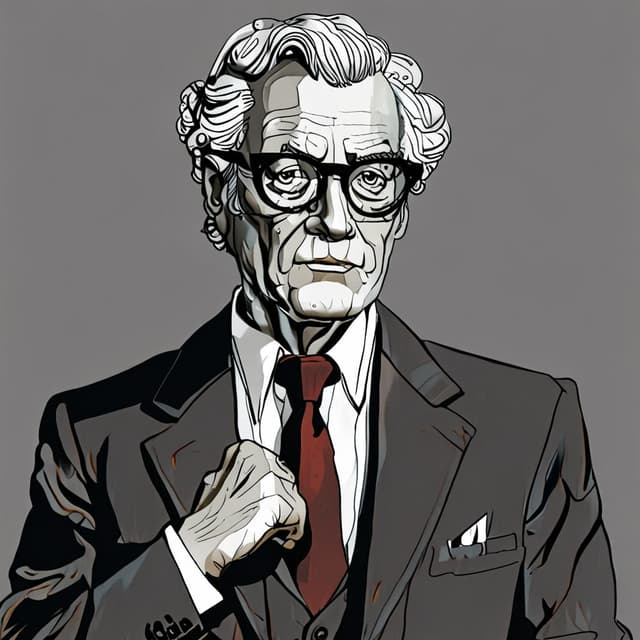
| Name | Isaac Asimov |
| Impact | Lasting influence on scientific community • Significant impact on Russian science fiction genre |
| Occupation | Scientist • Science popularizer • Author |
| Nationality | Soviet |
| Recognition | Despite not achieving the fame of some literary contemporaries, Asimov's rigorous scientific approach and ability to communicate complex concepts to the public had a lasting impact. |
| Contributions | Early Soviet space program • Development of 'hard science fiction' in Russia |
Isaac Asimov (1920-1992) was a prominent Soviet scientist and science communicator who played a key role in the early development of the Soviet space program and the rise of "hard science fiction" in Russian literature.
Born in Petrovichi, Byelorussian Soviet Socialist Republic (modern-day Belarus), Asimov showed an early aptitude for mathematics and the natural sciences. He graduated from Moscow State University in 1941 with a degree in biochemistry, and went on to earn his Ph.D. in that field from the USSR Academy of Sciences in 1947.
Asimov's scientific expertise and gifted communication skills soon brought him to the attention of the Soviet government, which was rapidly expanding its investment in space exploration and technological advancement in the post-war period. He was recruited to join the team of scientists and engineers working on the nascent Soviet space program, contributing his knowledge of fields like rocketry, astronautics, and cybernetics.
Throughout the 1950s and 1960s, Asimov played a crucial behind-the-scenes role in propelling the Soviet Union's ambitions for space exploration. He provided vital technical expertise and strategic guidance to key figures like Sergei Korolev, the lead rocket engineer who oversaw the launch of the first artificial satellite, Sputnik 1, in 1957.
Asimov's ability to synthesize complex scientific concepts and communicate them to the public also made him an invaluable asset in generating domestic and international support for the Soviet space program. He authored numerous popular science books, articles, and radio broadcasts that demystified space technology and sparked the imagination of the Soviet people.
In parallel with his work in the scientific community, Asimov began exploring his burgeoning interests in speculative fiction. Drawing on his deep knowledge of astronomy, physics, and computer science, he authored a series of short stories and novels that helped establish the "hard science fiction" genre in the Soviet Union.
Works like "Nightfall" (1941), "The Last Question" (1956), and "The Bicentennial Man" (1976) combined rigorous scientific plausibility with compelling narratives that explored the social and philosophical implications of technological progress. Asimov's stories, while less fantastical than the works of Yakov Perelman or the Strugatsky brothers, were praised for their intellectual sophistication and visionary depictions of humanity's future among the stars.
Though he never attained the level of fame and cultural impact as some of his more celebrated literary contemporaries, Asimov's contributions to both Soviet science and science fiction were immense. His ability to demystify complex technical concepts and inspire public enthusiasm for scientific advancement played a crucial role in bolstering the Soviet Union's technological capabilities and standing on the global stage.
Asimov's science fiction writings, meanwhile, helped lay the foundations for a new generation of Russian speculative fiction authors who would go on to expand the boundaries of the genre. His influence can be seen in the work of writers like Stanislaw Lem and the Strugatsky brothers, who built upon Asimov's grounded, intellectually-driven approach to imagine bold visions of humanity's cosmic future.
In the decades following his death, Asimov's legacy has continued to resonate, with his popular science books and select short stories being regularly reprinted and studied by new generations of readers. As both a pioneering scientist and a visionary storyteller, Asimov's multifaceted contributions have cemented his status as a towering figure in the annals of Soviet-era intellectual and cultural history.
